Dear Readers,
The field of social sciences is increasingly acquiring a more pluralistic and interdisciplinary character in its effort to make sense of the rapidly transforming social, cultural, technological, and communicational structure of today's world. The May 2026 issue of TAM Akademi places this pluralism at its center, presenting readers with a strong body of content that brings together different theoretical approaches, methodological diversity, and current social issues.
The studies featured in this issue reveal both how classical sociological and communication theories enable contemporary readings and how the new phenomena of the digital age must be rethought from the perspective of the social sciences.
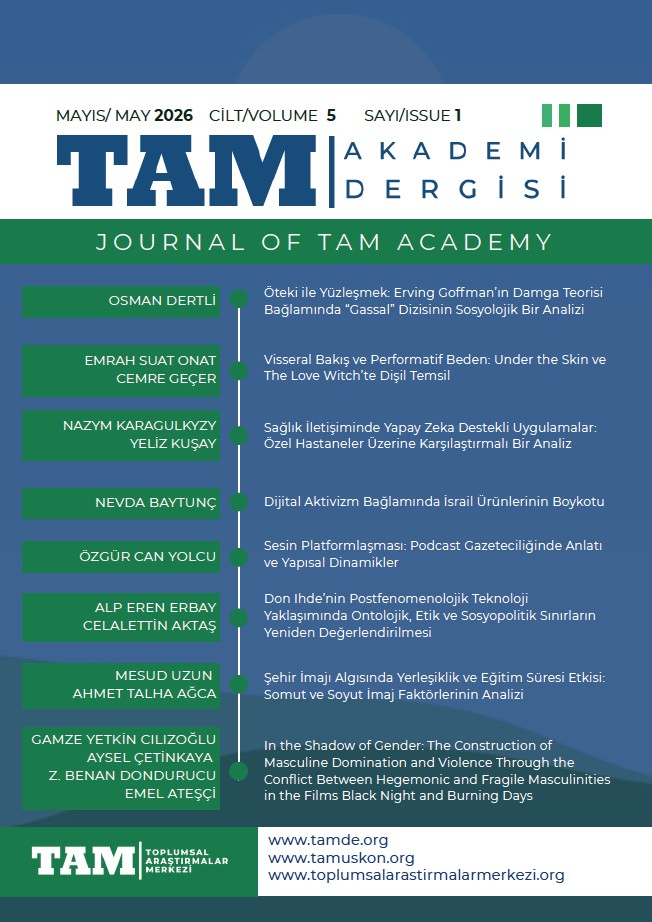
In his study titled "Confronting the Other: A Sociological Analysis of the Series 'Gassal' in the Context of Erving Goffman's Stigma Theory," Osman Dertli analyzes a contemporary television narrative through the lens of stigma theory, rendering practices of othering visible. This study opens up a discussion of social exclusion mechanisms through media representations.
In their article titled "The Visceral Gaze and the Performative Body: Female Representation in Under the Skin and The Love Witch," Emrah Suat Onat and Cemre Geçer focus on the representation of the female body in cinema, addressing the relationship between visuality, the body, and power in its visceral and performative dimensions.
In their study titled "AI-Supported Applications in Health Communication: A Comparative Analysis of Private Hospitals," Nazym Karagulkyzy and Yeliz Kuşay examine the transformation brought about by artificial intelligence in the field of health communication, discussing the impact of digitalization on institutional healthcare practices.
In her article titled "The Boycott of Israeli Products in the Context of Digital Activism," Nevda Baytunç addresses social mobilizations shaped within digital spaces and consumption-based forms of political protest.
In his study titled "The Platformization of Sound: Narrative and Structural Dynamics in Podcast Journalism," Özgür Can Yolcu analyzes the narrative strategies of podcast journalism as a rising media form and its position within the platform economy.
In their study reassessing ontological, ethical, and sociopolitical boundaries through Don Ihde's postphenomenological approach to technology, Alp Eren Erbay and Celalettin Aktaş offer an interdisciplinary contribution to the philosophy of technology.
In their research titled "The Effect of Residency and Duration of Education on City Image Perception: An Analysis of Concrete and Abstract Image Factors," Mesud Uzun and Ahmet Talha Ağca present the relationship between city image perception and sociodemographic variables from an empirical perspective.
Meanwhile, in their study titled "In the Shadow of Gender: The Construction of Masculine Domination and Violence Through the Conflict Between Hegemonic and Fragile Masculinities in the Films Black Night and Burning Days," Gamze Yetkin Cılızoğlu, Aysel Çetinkaya, Zeynep Benan Dondurucu, and Emel Ateşçi critically evaluate the phenomena of gender, masculinity, and violence through cinema.
The articles featured in this issue not only offer academic contributions from different disciplines but also generate new possibilities for thinking about the fundamental areas of debate in our era. Spanning a broad spectrum—including digitalization, social representation, power relations, body politics, the philosophy of technology, and urban perception—these studies once again demonstrate the critical and transformative quality of the social sciences.
We extend our thanks to all the authors who contributed and to the esteemed academics whose efforts went into the peer-review processes, and we wish to affirm that TAM Akademi will continue to contribute to the social sciences literature.
With our best regards,
The Editorial Board of Journal of TAM Akademi